Where do you find a competitor's revenue?
From its public accounts. Revenue, profit and average headcount can be looked up for free by tax ID on the official ANAF and Ministry of Finance pages.
Where do you find a restaurant's tax ID?
The easiest place is the receipt: it shows the company name and its tax code. If you don't have one, look at the footer of the restaurant's website or its terms and conditions page, where companies usually list their legal details.
One detail trips people up: the name over the door isn't always the name of the company. “La Grădină” may be run by a limited company with a completely unrelated name, and one company may run several venues or several brands. Before drawing conclusions, check that the company you found is really the one operating the place you have in mind.
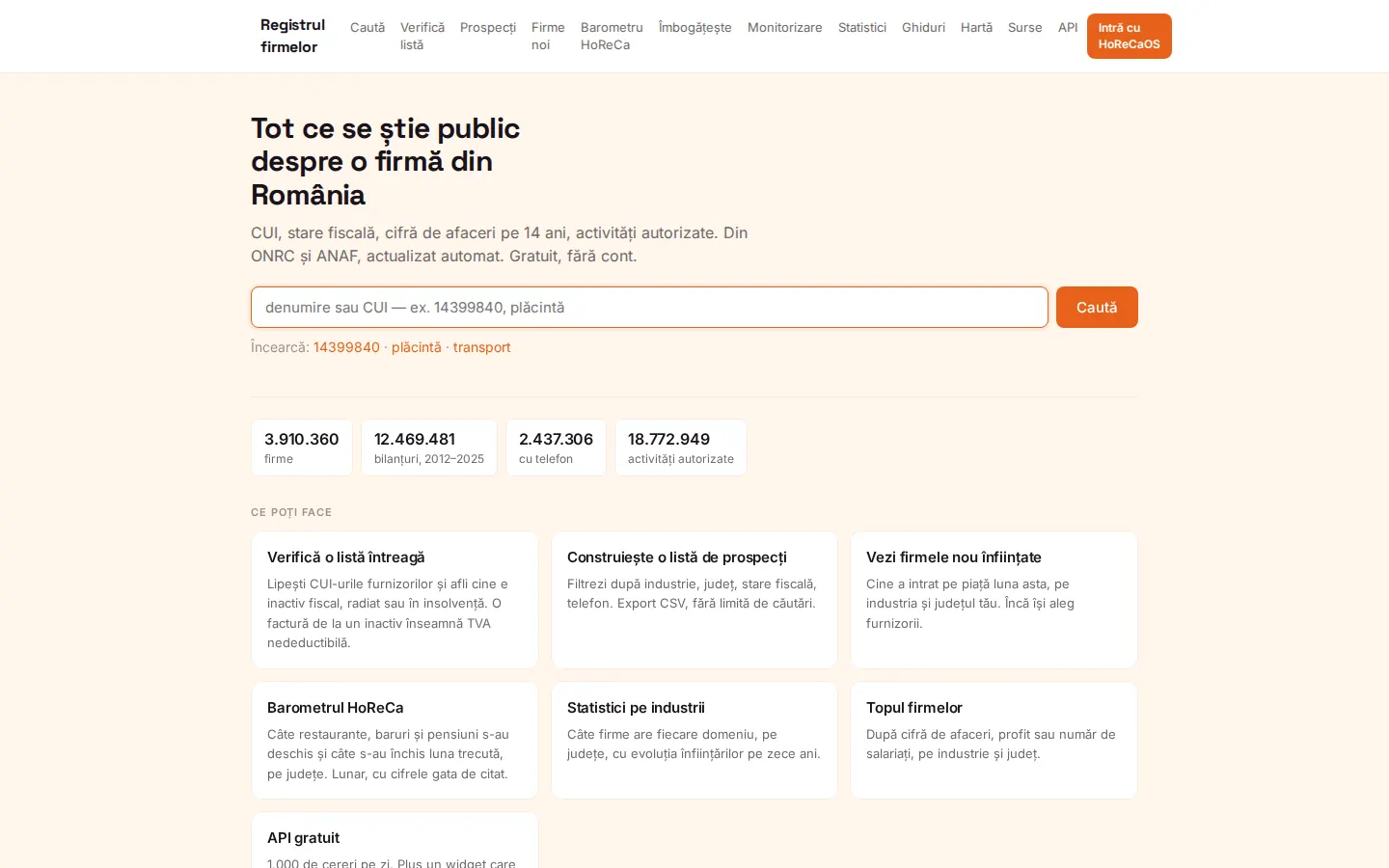
If all you have is the company name, search it in a company registry. The registry we built, registru.horecaos.org, brings together ANAF and ONRC data for about 3.9 million companies, with search by name or tax ID and one page per company.
Which figures in the accounts matter for a restaurant?
Revenue matters, but what's left of it and how it moves from year to year matter more. A competitor taking twice your revenue may earn less than you do, and a small one may be growing faster than anyone.
- Revenue: what the company took in over a year, excluding VAT. It shows size, not health.
- Net profit: what's left after every cost and tax. One loss-making year means little; three in a row mean a lot.
- Margin: profit divided by revenue. It's the figure that lets you compare a small venue fairly with a big one.
- Average headcount: set it next to revenue and you see how much the company takes in per person on the team.
- The trend over several years: a company growing steadily tells you more about the market than one good year.
What don't the accounts tell you about competitors?
The accounts don't tell you where the money comes from, or what is happening this year. They're an annual snapshot filed after the year closes, so the newest figures you'll see are usually last year's.
You can't see the split by channel either. The accounts won't tell you how much a restaurant sold in the dining room versus on Glovo, Bolt Food or Wolt, which dishes carry its margin or what it pays in rent. And if one company runs three venues, you see the total, not each venue.
Then there's the CAEN activity code. Companies declare a main activity, but some restaurants are registered under catering, cafés or something else, and some companies with a restaurant code actually do other work. When you compare, look at what the business really does, not just its code.
How do you compare yourself fairly with restaurants in your city?
Compare yourself with every company in your line of business in your city, over the same years, not with one competitor picked by eye. One neighbour can be an exception; dozens of companies in the same city show you where the middle of the market is and where you stand against it.
By hand, that means a list of companies, one tax ID search for each and a spreadsheet where you enter revenue, profit and headcount over a few years. It can be done, but it takes hours for a big city and it's easy to get a row wrong.
That's why we built the “How you compare to competitors” report. You enter your company's tax ID, your name, your email and your role, and within a few minutes you get a free PDF report by email, built from public financial statements. It compares you with companies in the same line of business in your city over the last 5 years: revenue, profit, margin and productivity, your place in the ranking, the biggest players, who is growing fastest and three recommendations.
The report is for information, not an official document: the data comes from ONRC open data and ANAF. For an official extract on a company, use the ONRC portal.
What do you do with the comparison?
Look for one question worth answering, not a list of worries. The comparison doesn't tell you what to do, but it shows you where to look first.
If your revenue is close to everyone else's but your margin is much lower, the problem is almost certainly in costs: menu prices, food cost or delivery platform commissions. If your margin is fine but you're growing more slowly than the market, the issue is more likely visibility and sales channels. If you take in much less per employee than the others, look at opening hours, shifts and how much time the team loses on work that could be simpler.
Look at the fastest growers too. Not to copy them, but to see what they share: a delivery channel, a neighbourhood, a type of menu. Then check in person: visit, order from them, read their reviews.
If you'd like to go through the numbers with someone, our HoReCa consulting works on exactly this: pricing, food cost, margins per channel and concept. Pricing is quoted on request, once we've seen where you're starting from.
Frequently asked questions
Is it legal to look at a competitor's figures?
Yes. The headline figures in company accounts are public precisely so that anyone can consult them. What isn't public is internal data: sales by product, individual salaries or contracts.
How much does the “How you compare to competitors” report cost?
Nothing. The report is free and arrives by email as a PDF. Signing up for the newsletter is optional; you get the report either way.
How recent are the figures in the accounts?
They're from the last closed year for which the company filed its accounts. The current year doesn't appear, so a recent change at a competitor, such as a new venue, only shows in the numbers a year later.
Can I find out how much a competitor sells on Glovo or Wolt?
Not from the accounts. They show the company total, with no split by channel. On the platforms you only see what's public: the menu, prices, position in the list and reviews.