Where do you start when you want to open a restaurant?
You start with the concept, not the premises: who you sell to, what you sell and why someone would pick you over the place across the street. A good concept fits in two sentences, for example “a quick lunch for the offices nearby” or “a neighbourhood bistro with a short menu and local produce”.
Put on one page your audience, the core menu, the price range you want the bill to fall in and the channels you sell through: dine-in, takeaway or delivery. That page keeps you on course when dozens of small decisions show up, from furniture to the name.
If you have never worked in a venue, spend a few weeks in one, even as an assistant. ZED-ZEN's founder has over 10 years in hospitality and has owned two cafés, and the lesson is the same for everyone who has been there: day-to-day operations surprise you more than the idea does.
How do you check on paper that the restaurant can make money?
You do a simple calculation before signing anything: what it costs to produce each dish, what you take in for it and what is left after rent, staff and utilities. You don't start from a dreamed-up turnover, but from how many covers you can realistically serve per day.
The first number that matters is food cost: the cost of the ingredients in a dish relative to its selling price. You work it out per recipe, with real supplier prices. We have a separate guide on how to do it, with step-by-step examples.
Then you set fixed costs next to cautious sales. If the place loses money even in the optimistic version, you change the concept, the premises or the menu rather than hope it fixes itself after opening. Margins differ by channel because delivery apps take a commission: check the current rate in the contract each one offers you.
- Food cost for every dish, worked out with current supplier prices.
- Monthly fixed costs: rent, staff, utilities, accounting, maintenance.
- Cautious daily sales, by channel: dine-in, takeaway, delivery.
- A cash reserve for the first months, when sales grow slowly.
What paperwork and permits does a restaurant need?
In broad terms you need a company with restaurant activity in its scope, premises zoned for the purpose and the operating approvals required for public catering. The exact lists depend on the town, the type of venue and what you cook, so don't copy them from an article, this one included.
The steps are the same in any city: you settle the company form and activity code with an accountant, check with the town hall that the premises can operate as a restaurant, then ask the public health and food safety authorities which approvals your kitchen needs. There is also fire safety and staffing: contracts, medical records, training.
Always check the current requirements on the institutions' official pages and get what you are told confirmed in writing. The most expensive way to find a gap is to discover it after you have already fitted out the space.
How do you choose the location and the premises?
You choose the location by the customer in your concept, not by the lowest rent. A quick lunch place needs offices close by and foot traffic at midday; an evening bistro needs an area where people stay after work.
Before you decide, stand in front of the premises at different hours and count who walks by. Also check how easily suppliers can reach it, where ventilation and storage go, how many seats fit and whether the place can handle deliveries without blocking the street.
The lease matters as much as the place: its length, how the rent is indexed and what happens if you don't get a permit. Have someone who knows commercial contracts read it.
What do you set up online before opening?
Before opening day you need at least a clear name and logo, a complete Google listing with hours, address and photos, and a place where customers can see the menu and contact you. Without them, people searching for you on opening day find nothing.
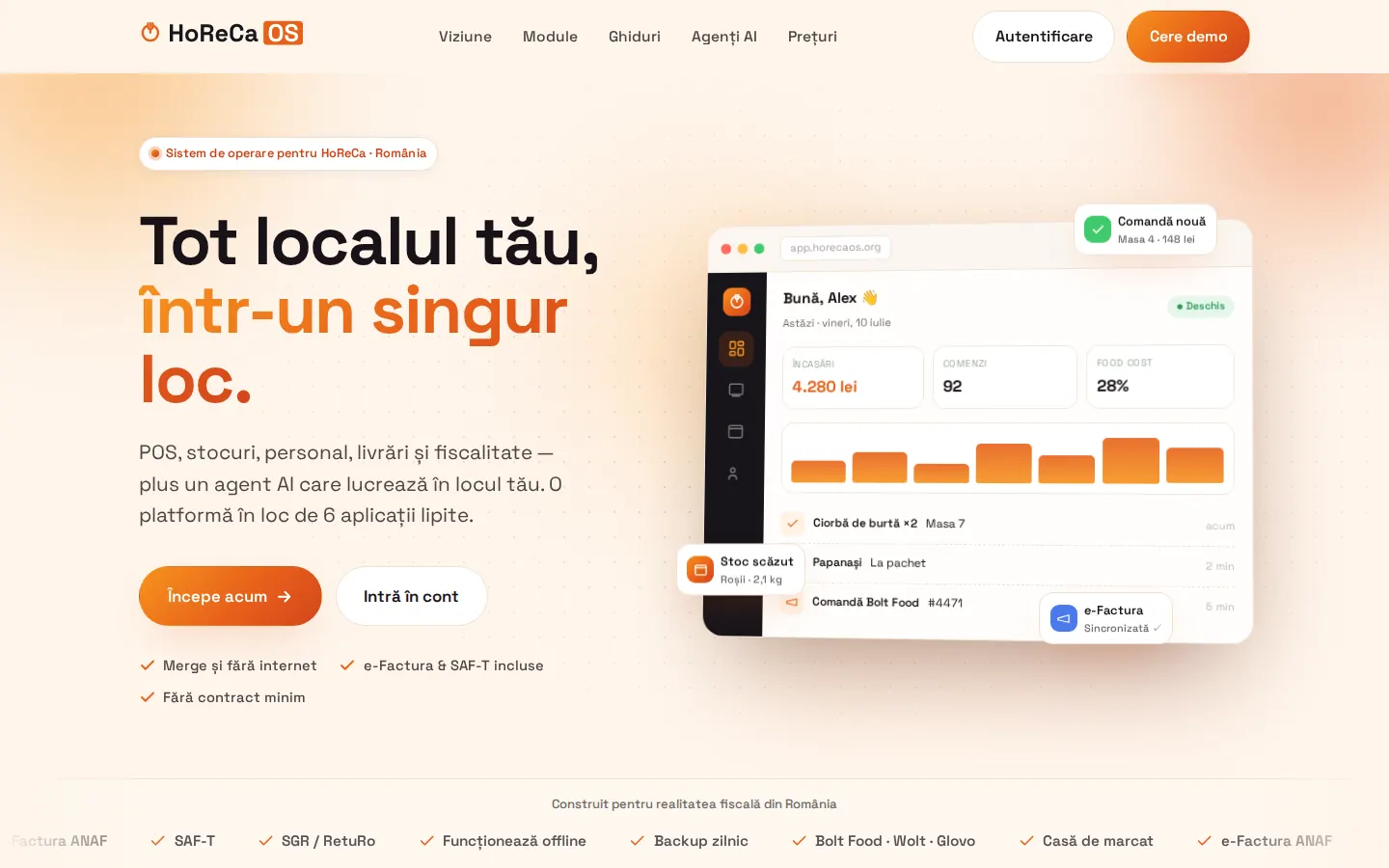
A presentation website with a digital menu starts from 1,500 RON at ZED-ZEN, with the first year of hosting included, and branding (logo and kit) from 500 RON. If you want to skip printed menus, read about the QR-code digital menu too. For orders, bookings and day-to-day management, HoReCaOS starts from 5 € a month per module.
For delivery, opening an account on the apps takes time and a well-prepared menu, with clear photos and descriptions. Check each platform's current terms, because they change.
What are the common mistakes when opening a restaurant?
The most common mistake is spending on the fit-out money that should have stayed as a reserve. A beautiful venue with no cash for the first months closes before it finds its customers.
The second is a menu that is too long and built without a food cost calculation. The third is learning only after renting the space which approvals your activity needs. Rushed hiring without training is common too, as is having no opening-day plan, with customers who don't know you exist.
- No cash reserve for the first months.
- A menu that is too long, with no food cost worked out.
- Approvals checked only after signing the lease.
- No online presence at opening.
Steps
- Write the conceptAudience, core menu, price range and sales channels, on a single page.
- Work out the numbersFood cost per dish, monthly fixed costs and cautious daily sales.
- Sort out the paperworkThe company, the zoning of the premises and the approvals local authorities require for public catering.
- Pick the locationBased on the customer in your concept; check foot traffic, suppliers and the lease.
- Build the menu and pricesA short menu, prices from cost and margin, separate prices for the delivery channel.
- Prepare your online presenceName and logo, Google listing, menu and contact visible before opening.
Frequently asked questions
How do you organise a new restaurant?
You split the work into four areas: the floor, the kitchen, supply and stock, and administration (paperwork, payments, accounting). Each area has an owner, written rules for goods receiving and for shifts, and the day's numbers get checked in the same order every evening.
How long does it take to open a restaurant?
It depends on the premises, the fit-out and how long approvals take in your city, so there is no fixed duration. The safest way is to ask each institution and each supplier for their timeline in writing and add a safety margin.
Do I need a website for a restaurant?
Yes, a place of your own where customers find the menu, hours, address and a way to get in touch. It can be simple: a presentation site from 1,500 RON at ZED-ZEN, with the first year of hosting included.
Can you help me open a restaurant?
Yes, through HoReCa consulting: food cost, prices and margins by channel, concept, virtual brand and an opening plan. Pricing is quoted on request, once we see your situation.